
Rejection Sensitivity, ADHD, and the Case of the Missing Symptom
Why a small correction can take down an entire day ADHD readers, or anyone whose attention is already drifting: the condensed version...

Trauma-Informed Psychological Care
Trauma-informed therapy and psychological evaluation for children, teens, adults, and families in Townsend, Delaware. A community where you are understood first, and cared for from there.
 Our walking path
One practice, three paths
Clinical care, professional education, and writing, each with its own focus and its own door.
For children, teens, adults, and families.
Continuing education, supervision, and consultation.
Essays and books on psychology and being human.

Our Mission
We balance treatment shaped to each person with the most current research and training.
That community has grown into training the clinicians who carry the standard forward, and into writing that asks readers to think critically about what they are told about mind, body, spirit, and our connection to nature.
Areas of Focus
Attuned, nervous-system-aware care for trauma and its lasting effects.
ADHD, autism, and diagnostic clarification for children, teens, and adults.
Developmentally informed support across the lifespan and for families.
Evidence-based care for anxiety, depression, grief, and transitions.

Meet the Practice
“My approach to care begins with the understanding that each person is unique. Treatment should be thoughtful, responsive, and grounded in both clinical depth and the needs of the individual.”
Niki Serravalle, PsyD, LPCMH, NCC
Our Team

PsyD, LPCMH, NCC
Owner and Clinical Director
Read bio Dr. Niki Serravalle
Practice Manager
Email Jada Jada Senter
Assessment Team Lead
Email Kim Kim Shiflett
LPCMH, NCC
Therapist
Read bio Amanda Foxwell
LACMH, NCC
Therapist
Read bio Brianna Patton
LPCMH, NCC
Therapist
Read bio Brittany Heitmann
LACMH, NCC
Therapist
Read bio Kirsten Lowe
Doctoral Psychology Assistant
In the Community
Provider evenings on our property, chamber dinners, a holiday door contest, and a crab feast. One issue a year, about the people we work beside and the places we show up.
 Our meditation path
Our philosophy of care
Healing happens in relationship. We pair evidence-based care with warmth, attunement, and a holistic approach to mind, body, and spirit.
Center for Balanced Living provides trauma-informed therapy and psychological evaluation to Middletown, Townsend, Odessa, and the greater MOT area, with clients across New Castle County and Delaware including Wilmington, Newark, and Dover.
From the Blog
Grounded, research-informed writing on therapy, evaluation, and the cultural moment.
Why a small correction can take down an entire day ADHD readers, or anyone whose attention is already drifting: the condensed version...
Most of us are stressed most of the time. A stress disorder is defined by something else: what has happened to your...
Why every planner you have bought is still in a drawer ADHD readers, or anyone whose attention is already drifting: the condensed...
Not a book club. I have already read these. Each subject gets a shelf and each week gets one book: what it gets right, what to hold loosely, and whether it belongs on your shelf.
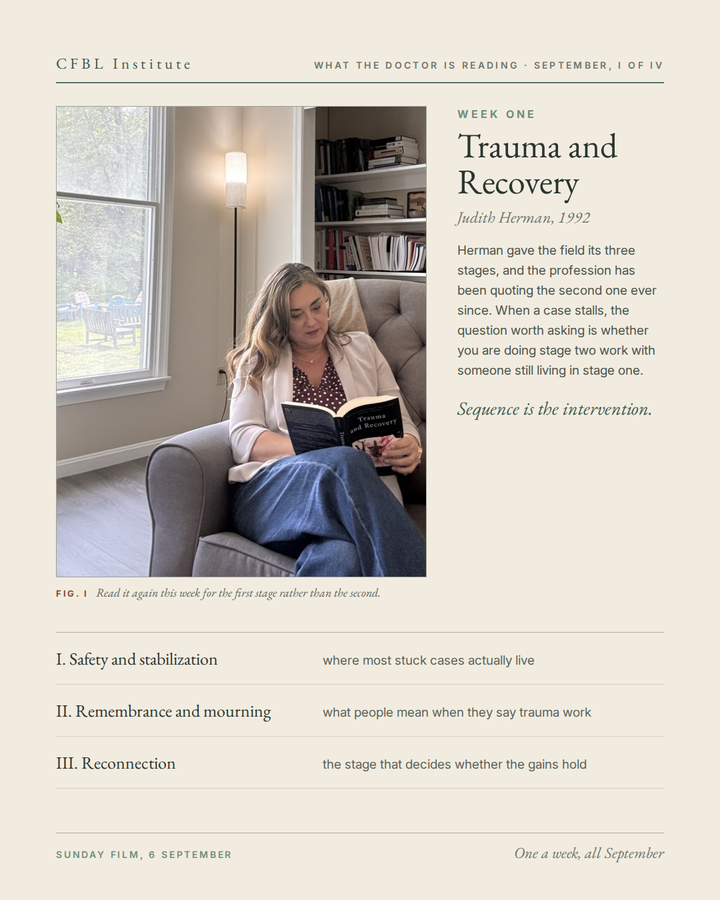
Film on Sunday, September 27
Judith Herman, 1992
Why read it
Herman called stage one safety and stabilization. We have newer language for it now, but the clinical problem she identified has not changed. Stage one is not teaching coping skills so that we can get to the work. It is the work. Most stuck cases are stage one problems being treated as stage two.
Worth knowing
Many clients with complex histories can begin processing sooner than a strict phase model suggests (de Jongh et al., 2016).
Best for
Clinicians early in trauma work, and anyone whose cases keep stalling once processing begins.
Where its central claim sits
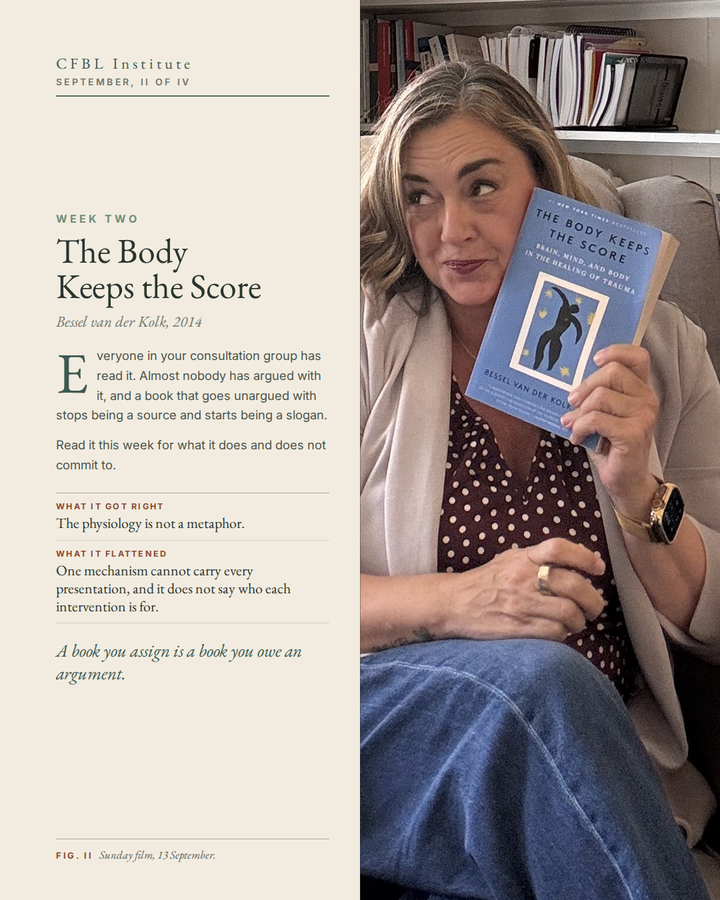
Film on Sunday, October 4
Bessel van der Kolk, 2014
Why read it
It moved trauma beyond the idea that suffering lives only in thoughts and memories, and it made the body impossible to ignore. Still worth reading. Also worth arguing with.
Worth knowing
The body carries patterns rather than stored files, and those patterns look different in every client. The book draws on polyvagal theory, which research is still testing (Grossman, 2023).
Best for
Clinicians who need the body in the case conceptualization. Read it alongside a critique.
Where its central claim sits
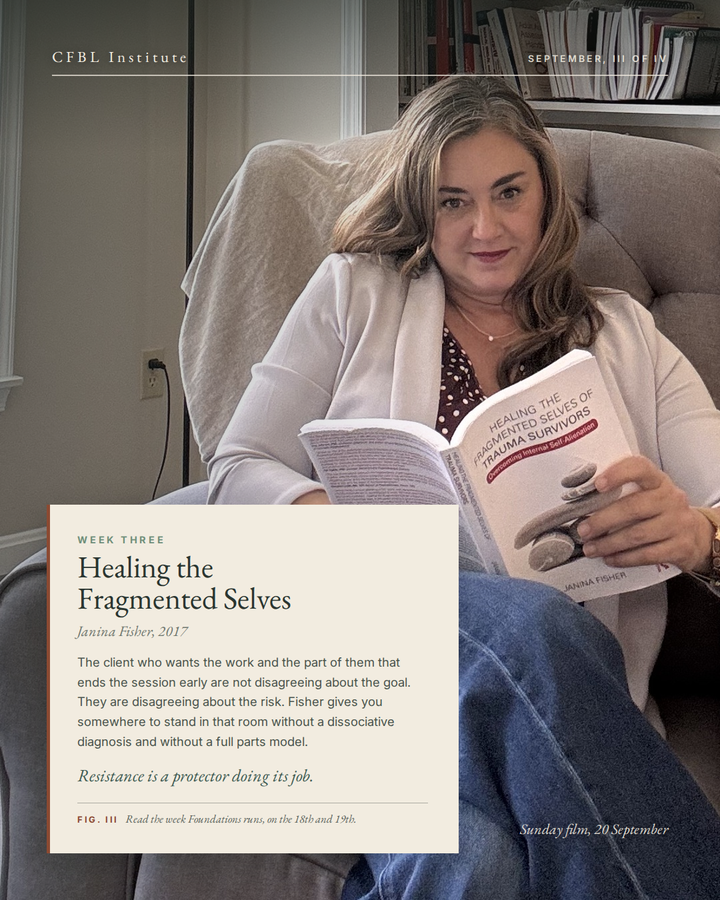
Film on Sunday, October 11
Janina Fisher, 2017
Why read it
Internal contradiction is not necessarily resistance. Fisher gives clinicians a way to work with the client who wants treatment and dreads every session, without turning that into pathology or noncompliance. We stop trying to make one part win.
Worth knowing
Parts language is a useful clinical map. Research on the structure beneath it is still developing.
Best for
Clinicians whose clients seem to get in the way of their own treatment.
Where its central claim sits
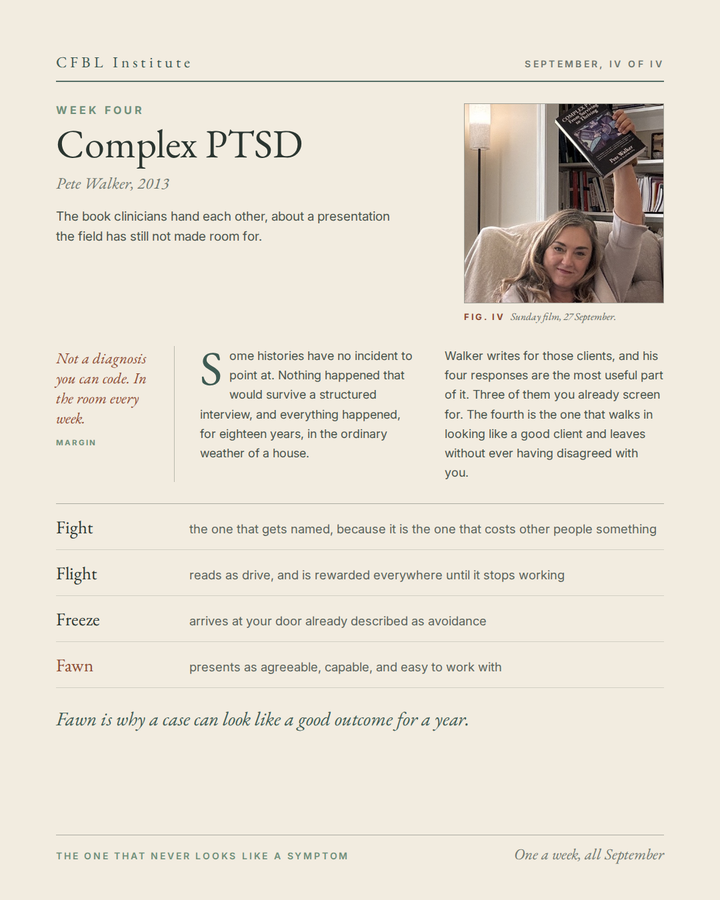
Film on Sunday, October 18
Pete Walker, 2013
Why read it
Some histories have no single event in the timeline. Walker gave us language for emotional flashbacks without a visual narrative: a client suddenly feels very young, ashamed, trapped or defective, and does not know why.
Worth knowing
Not every difficult childhood is a trauma diagnosis. Complex PTSD is recognized in ICD-11, and the fawn response is a newer idea that research is still catching up to.
Best for
Clinicians working with adults whose history is a developmental environment rather than an event. Readable for many clients as well.
Where its central claim sits
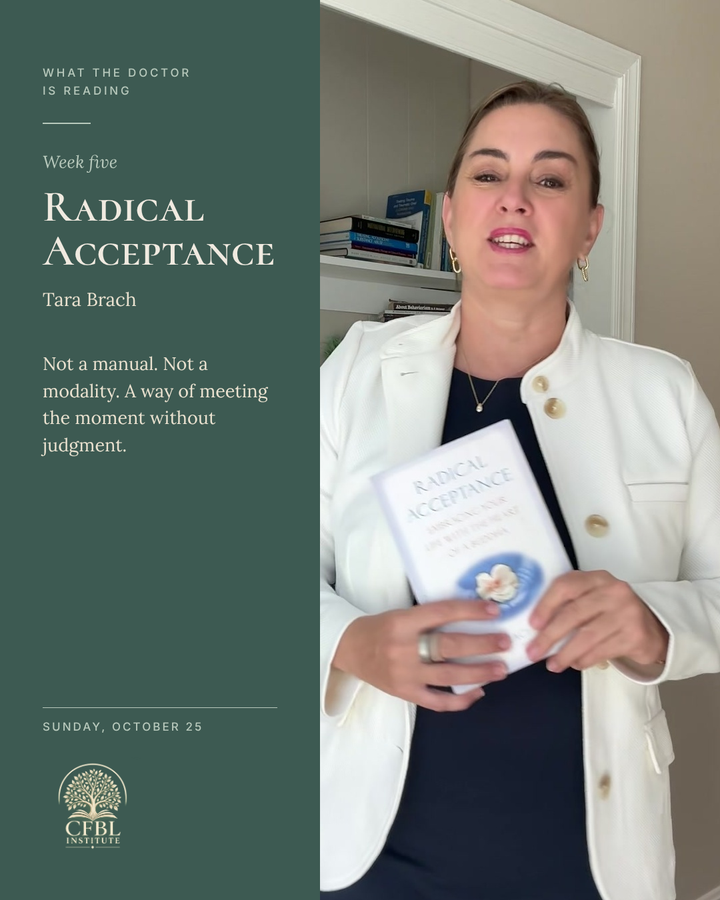
Film on Sunday, October 25
Tara Brach, 2003
Why read it
Not a manual and not a modality. A way of meeting what is here without judgment, which is harder than it sounds and more useful in the room than most techniques. Read it, then practice it.
Worth knowing
It is a practice book rather than a treatment protocol, and its ideas share roots with acceptance-based therapies such as ACT and DBT.
Best for
Clinicians building their own capacity to stay present with what they cannot fix.
Where its central claim sits
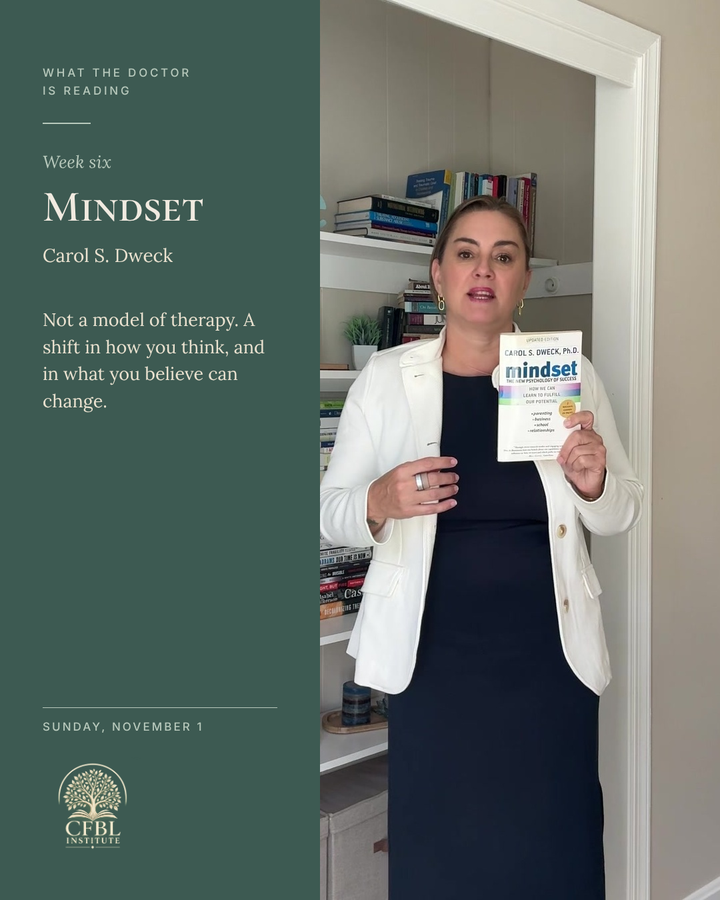
Film on Sunday, November 1
Carol S. Dweck, 2006
Why read it
Not a treatment model. A way of thinking: the shift from a fixed to a growth mindset, and what changes when you apply it to business, sports, health care and relationships.
Worth knowing
Growth mindset research shows real but modest effects, strongest for students who are struggling (Sisk et al., 2018; Yeager et al., 2019).
Best for
Supervisors, educators, and clinicians who coach or teach.
Where its central claim sits
Every book is sorted by where its central claim sits: established, emerging, theoretical, or clinical wisdom. Clinical wisdom is not a dismissal. It is often right and simply has not been tested yet.
Letters From the Practice
Subscribe for letters from the practice, plus news on services and events. No noise, just the work.
Your email is never shared.
Questions, Answered
Practical answers about scheduling, insurance, evaluations, and finding the right fit.
Call us at (302) 608-3780 or use our contact form. We typically respond within 24-48 hours to find a time that works.
We are in network with Aetna, Highmark Blue Cross Blue Shield of Delaware, Highmark Health Options, and Medicare. We can also review out-of-network benefits and self-pay options with you before anything is scheduled.
Evaluations begin with careful listening and history, followed by standardized assessment and a clear written summary with recommendations and next steps.
Fit matters. Our first conversation is a chance to understand your goals and determine whether our services are right for you, or to offer a referral if another setting would serve you better.
Take the Next Step
Whether you are seeking therapy, an evaluation, consultation, or training, we are here to help you take a clear next step.
This is not for emergencies. If you are in crisis, call 988 or 911, or go to your nearest emergency room.


